A few years back when Supreme Court Judge Samuel Alito was going through Senate confirmation, I was watching the hearings on CSPAN. I know, I know. It’s not as important as ESPN, MTV, or CNN Headline News, but I was watching it. Essentially, the hearings consisted of a bunch of Judge Alito’s friends and colleagues providing testimony about his views and his character. I like that for some reason. What would it be like if all your friends had to testify about your character? Whoa.
I only remember one quote out of the whole time I watched. One of Judge Alito’s colleagues, a fellow judge, I think, made one remark that stuck with me. He said, “He does not mistake the obscure for the profound.”
When I heard that, I said to myself, I want to be like that someday (but I have no clue how to). I think it struck me because I recognize how easily I seek out the obscure for its obscurity or its cleverness or its newness. Being the first to find something garners high praise these days. Maybe it’s just me being white.
In a culture of “lies, hype, and spin,” the possibility of discovering a diamond in the rough is something that feels authentic and genuine, not pushed upon us by advertisers. The disillusionment comes when we find someone who found it before we did. This happened to me when I was talking with my friend Dan about The Myriad. Music is a popular segment of white culture where we search for the obscure in pursuit of the profound. This is probably why we like to root for the underdog too: They’re less popular (see Aladdin, whom Jafar calls “a diamond in the rough”).
But Judge Alito, according to his colleague, knows how to place value in proportion to its significance. He judges well. And that’s something I would love to be true of me, but I just get distracted and read blogs. Placing my values and affections on worthwhile things is part of what I think Christian spirituality is about: seeing what God values and valuing it in a similar proportion. Most of my brokenness expresses itself by mistaking the worthless for the worthwhile. I run after things will make me happy, comfortable, or safe. Meanwhile, God is calling for sacrifice, struggle, and danger, but only because the rest of the world lives in contradiction to how God set the world up to run.
For me, maybe watching CSPAN instead of MTV, ESPN, or CNN was a subconscious attempt to find something of lasting value from a medium that pushes short-term benefits. And therein lies the paradox: I was again looking for the profound from an obscure TV network, and this time I found it. In a culture of “lies, hype, and spin,” a tyranny of the loudest voices and biggest shows drives out the voices of lasting value (still, small ones?) and shows of real significance.
And so, our ongoing search for the profound leads us into the realm of the obscure, but only because the realm of the obvious is ruled by the trivial. And perhaps it echoes another way of seeing the world, one in which the visible things are temporary and invisible things eternal. But seeing the world with eyes for the eternal means going beyond the five senses. And I think that’s what he meant when he said, “Those who have eyes to see and ears to hear should listen and understand.”
Articles that inspired this post:
How Small Stories Become Big News from Politico.com
The Twelve Men from G.K. Chesterton (HT: Chaka; HT: JT; HT: John Piper)
Technolochurch from Ed Stetzer
How Technology Relates to Permanence, and What That Means for Christianity from Consumed
The Internet Effect on News from Time Mag's Swampland
Saturday, May 31, 2008


Wednesday, May 28, 2008
Indy Marathon

There is another big race in the State of Indiana this month, the Sunburst Marathon.
Something that is a big part of my life, but I don't talk too much about, is physical activity. I think it is an important part of spirituality. So multiple times a week I play soccer with the teams, bike to work, lift, or run. I find the communal physical activities (soccer, biking, softball) to be really rewarding because it draws me alongside other people.
The more personal exercises are rewarding as well but much more difficult. Running for me has been highly personal since college and an activity I enjoy. Right now, as much as aI love running and races, I don't think I could do a marathon. Give me some 5Ks and I'm there but 26.2 miles sounds daunting.
Which is why I have mad props for people who run marathons. So I'm giving it up to my brother in law, Eric, who is running the Indianapolis Marathon this weekend.
You thought the State of Indiana possessed the city of South Bend. Yes, that is right for now. But after this week it will belong to Eric Weiss because he is going to "own" that Marathon. Get it done bro!
Blogging, or How to Converse in a Group Setting
Back in the day, or so I've heard, guys and girls went to dances without dates. At one dance, a guy with a wooden-eye showed up. With his other eye, across the dance floor, he spotted a girl he wanted to dance with. Her only defect with a hair-lip. Getting up the nerve, he finally stood and crossed the gymnasium. She saw him coming and grew nervous and excited.
"Would you like to dance?" the guy sputtered.
"Would I! Would I!" she exclaimed.
His heart beating with anxiety turned quickly to anger. "Hair lip! Hair lip!" he retorted and stomped away.
My dad told me this joke. Then he told me about the time his garrulous pastor began to tell it to a new acquaintance. It wasn't until halfway through the joke that the pastor realized: He was telling the joke to a man with a hair-lip.
What are you saying, and who's listening?
When I started reading blogs a few years ago, one of the blogs I found was from a then-fellow Minnepolitan (?). He wrote a lot about theology and relationships. I enjoyed both, but among my favorites were his writing on the subject of awkwardness and his articulation of the ladder theory of relationships. I recently returned to his site to find it a shell of the blog I remember. It had been transformed. I went to his profile page and found this:
On my old blog I used to tell a lot of stories about awkwardness. I love awkwardness. But I don't so much anymore. Telling stories involving other people and posting them on the Internet for all to see usually embarrasses them in ways they rather not be. So I don't do that as much. My rules of blogging basically boil down to 1) never blog about your dating life, 2) never blog about your work, 3) never blog about stuff that gets said about so-and-so at church. Learned the hard way on all of them.
His shift away from awkwardness I attribute to a bit of maturing in his late 20s. But these other things, it seems, are a few painful pearls of wisdom. He writes out of experience. Perhaps any of his three rules could be broken, but not without caution.
I was talking to some colleagues about the relational impact of blogs. One colleague told me how she had an acquaintance who had started reading her personal blog. My colleague writes about herself, her concerns, and her interests. As a result, her acquaintance found that they had more in common than either one had realized. These common interests helped them move from acquaintances to friends.
These two stories and their opposite outcomes make me wonder what made them turn out so different. These consequences are significant. Discerning their differences, seems valuable to reap the benefits and avoid the perils. I see two variables distinguishing these stories: who you're writing to and what you're writing about.
Who are you writing to? For me, I know that my colleagues and my roommates read this. I have a responsibility, like it or not, to consider whether what I say may communicate something I don't mean or something I do mean but shouldn't say.
Maybe your grandmother isn't reading your blog, but would you be concerned if she did? Of course, she's not interested in your rock'n'roll, but she's interested in you, so she may read it anyway.
What are you writing about? Writing about impersonal topics like book reviews, political analysis, gaming news, or business advice has little bearing on your relationships with friends and loved ones. Writing about your love life, your weird family, your personal beliefs, or your job all have the potential of revealing more than you intended and to people closer than you expected.
Acquaintances have no context for why you've been thinking about jealousy lately, but those close to you can probably make a good guess. And even if they're wrong, they might never know that. This can create (sometimes, unnecessary) resentment, hurt, or distance in a relationship. You may be vague and oblique as to why you've been feeling jealous lately, but those close to you will care enough to wonder why.
As I listed tips for text messaging in my last post, I noticed that they were simply good tips for any interpersonal communication-not limited to texting. Similarly, when blogging, thinking about what you're saying and whom you're saying to are good considerations for any group context.
Principles that make good communication, make good high-tech communication too.
"Would you like to dance?" the guy sputtered.
"Would I! Would I!" she exclaimed.
His heart beating with anxiety turned quickly to anger. "Hair lip! Hair lip!" he retorted and stomped away.
My dad told me this joke. Then he told me about the time his garrulous pastor began to tell it to a new acquaintance. It wasn't until halfway through the joke that the pastor realized: He was telling the joke to a man with a hair-lip.
What are you saying, and who's listening?
When I started reading blogs a few years ago, one of the blogs I found was from a then-fellow Minnepolitan (?). He wrote a lot about theology and relationships. I enjoyed both, but among my favorites were his writing on the subject of awkwardness and his articulation of the ladder theory of relationships. I recently returned to his site to find it a shell of the blog I remember. It had been transformed. I went to his profile page and found this:
On my old blog I used to tell a lot of stories about awkwardness. I love awkwardness. But I don't so much anymore. Telling stories involving other people and posting them on the Internet for all to see usually embarrasses them in ways they rather not be. So I don't do that as much. My rules of blogging basically boil down to 1) never blog about your dating life, 2) never blog about your work, 3) never blog about stuff that gets said about so-and-so at church. Learned the hard way on all of them.
His shift away from awkwardness I attribute to a bit of maturing in his late 20s. But these other things, it seems, are a few painful pearls of wisdom. He writes out of experience. Perhaps any of his three rules could be broken, but not without caution.
I was talking to some colleagues about the relational impact of blogs. One colleague told me how she had an acquaintance who had started reading her personal blog. My colleague writes about herself, her concerns, and her interests. As a result, her acquaintance found that they had more in common than either one had realized. These common interests helped them move from acquaintances to friends.
These two stories and their opposite outcomes make me wonder what made them turn out so different. These consequences are significant. Discerning their differences, seems valuable to reap the benefits and avoid the perils. I see two variables distinguishing these stories: who you're writing to and what you're writing about.
Who are you writing to? For me, I know that my colleagues and my roommates read this. I have a responsibility, like it or not, to consider whether what I say may communicate something I don't mean or something I do mean but shouldn't say.
Maybe your grandmother isn't reading your blog, but would you be concerned if she did? Of course, she's not interested in your rock'n'roll, but she's interested in you, so she may read it anyway.
What are you writing about? Writing about impersonal topics like book reviews, political analysis, gaming news, or business advice has little bearing on your relationships with friends and loved ones. Writing about your love life, your weird family, your personal beliefs, or your job all have the potential of revealing more than you intended and to people closer than you expected.
Acquaintances have no context for why you've been thinking about jealousy lately, but those close to you can probably make a good guess. And even if they're wrong, they might never know that. This can create (sometimes, unnecessary) resentment, hurt, or distance in a relationship. You may be vague and oblique as to why you've been feeling jealous lately, but those close to you will care enough to wonder why.
As I listed tips for text messaging in my last post, I noticed that they were simply good tips for any interpersonal communication-not limited to texting. Similarly, when blogging, thinking about what you're saying and whom you're saying to are good considerations for any group context.
Principles that make good communication, make good high-tech communication too.
Saturday, May 24, 2008
White Bread

I just got "marketed." Being marketed is becoming a victim of a ploy by a commercial organization trying to sell their product.
So I'm at Panera with Dan and Rachael. I went to get some food and recalled that you can order slices of their bread. I was in a bread mood so I thought, "why not?"
Looking over my options I saw Whole Grain White Bread. I thought, "Wow. What's so special about that? Whole Grain White Bread. Amazing!"
After I ordered and brought it back Dan and Rach asked what I got. I proudly told them, Whole Grain White Bread." Like it was some hidden relic I unearthed from the catacombs of an Italian bakery.
Dan looked at me, "You got white bread?"
And I realized I just ordered two slices of white bread. (Although I did put honey and butter on it) (And I'm sure my order entertained the 18 year old working the counter).
So after realizing my random decision and trying to rationalize it to them, with no avail, I told them I was going to try all of Panera's bread and rate it on my blog. (Which I won't do).
If you want to know, Panera's Whole Grain White Bread taste like...well...like white bread.
But...it's whole grain!
Here's what we do know: Nobody wants church as usual.
I find myself stuck between (at least) two worlds: the emerging church and the new calvinists. Christianity Today posted a dialogue between a leader from each movement--Tony Jones and Collin Hansen. (Both of whom, of course, just happened to have newly published books.) Here is CT's preface to the conversaton:
Tony Jones is the national coordinator of Emergent Village and author of The New Christians: Dispatches from the Emergent Frontier. Collin Hansen is editor-at-large of Christianity Today and author of Young, Restless, Reformed: A Journalist's Journey with the New Calvinists. Both books take a sympathetic journalistic approach to a young but growing movement in American Christianity, examining why it's growing and how it's changing the larger church.
Their conversation--"Emergent's New Christians and the Young and Restless Reformed"--comes in 5 parts.
Part 1
Part 2
Part 3
Part 4
Part 5
In part 4, I resonated with Tony's critique of Reformed leaders' public image:
I appreciate that the young Reformed folks consider their older leaders to be humble, but that doesn't always come across in the clips I see and the books I read. They may be humble in the face of the sovereign God, but they don't seem to preach with much epistemic humility.
The Suburban Christian posted interesting excerpts from these books as well, detailing a conversation between Tony Jones and John Piper, from both points of view. This particular exchange shocked me, as I am a big fan of Piper.
I mentioned that it might be arrogant and a bit deceptive to preach that one of them is the sole and exclusive means of understanding the single greatest event in the history of the cosmos: the crucifixion and resurrection of Jesus. “What do you tell your congregation about how Christians understood the atonement for the thousand years prior to Anselm?” The pastor [Piper] paused, looked at me, and said, “You should never preach.”
I still can't believe that I'm reading that right. Jones is, in content, attacking the epistemological arrogance that seems apparent (and it could be simply appearance) among Reformed theologians (despite TULIP's "total depravity" and 1 Cor 12:13), but Piper in context is displaying such arrogance as well. This exchange could, of course, be completely misconstrued and out of context.
And Challies, a veritable blogging amplifier for the Reformed camp, posted a review of Shane Claiborne's The Irresistable Revolution, exemplifying some of the attitudes that seem to pervade the Reformed/Emergent debate. Among them, he seems to parrot Piper's doctrinal demand for penal substitutionary atonement:
The message Claiborne teaches, preaches and models is not a gospel of salvation through the atoning death of Jesus Christ. It is not a gospel that saves souls as much as it is a gospel that brings wealth to the poor and sustains the health of the planet.
It seems that, behind the apparent theological disagreements (and it could simply be appearance), there is a more fundamental difference in epistemology (despite TULIP's "total depravity" and 1 Cor 12:13). Piper suggests so himself:
There are profound epistemological differences—ways of processing reality—that make the conversation almost impossible, as if we were just kind of going by each other. What is the function of knowledge in transformation? What are the goals of transformation? We seem to differ so much in our worldviews and our ways of knowing that I’m not sure how profitable the conversation was or if we could ever get anywhere.
Hansen and Jones' discussion does, in some sense, seem to "just kind of go by each other" too. They ask each other questions, but don't answer the other's. Fortunately, it is neither camp which builds the Church and finding common ground is not the prerequisite to accomplishing such a task.
Here is the man called the Branch. He will branch out from where he is and build the Temple of the Lord. Yes, he will build the Temple of the Lord. Then he will receive royal honor. --Zechariah 6:12-13
Tony Jones is the national coordinator of Emergent Village and author of The New Christians: Dispatches from the Emergent Frontier. Collin Hansen is editor-at-large of Christianity Today and author of Young, Restless, Reformed: A Journalist's Journey with the New Calvinists. Both books take a sympathetic journalistic approach to a young but growing movement in American Christianity, examining why it's growing and how it's changing the larger church.
Their conversation--"Emergent's New Christians and the Young and Restless Reformed"--comes in 5 parts.
Part 1
Part 2
Part 3
Part 4
Part 5
In part 4, I resonated with Tony's critique of Reformed leaders' public image:
I appreciate that the young Reformed folks consider their older leaders to be humble, but that doesn't always come across in the clips I see and the books I read. They may be humble in the face of the sovereign God, but they don't seem to preach with much epistemic humility.
The Suburban Christian posted interesting excerpts from these books as well, detailing a conversation between Tony Jones and John Piper, from both points of view. This particular exchange shocked me, as I am a big fan of Piper.
I mentioned that it might be arrogant and a bit deceptive to preach that one of them is the sole and exclusive means of understanding the single greatest event in the history of the cosmos: the crucifixion and resurrection of Jesus. “What do you tell your congregation about how Christians understood the atonement for the thousand years prior to Anselm?” The pastor [Piper] paused, looked at me, and said, “You should never preach.”
I still can't believe that I'm reading that right. Jones is, in content, attacking the epistemological arrogance that seems apparent (and it could be simply appearance) among Reformed theologians (despite TULIP's "total depravity" and 1 Cor 12:13), but Piper in context is displaying such arrogance as well. This exchange could, of course, be completely misconstrued and out of context.
And Challies, a veritable blogging amplifier for the Reformed camp, posted a review of Shane Claiborne's The Irresistable Revolution, exemplifying some of the attitudes that seem to pervade the Reformed/Emergent debate. Among them, he seems to parrot Piper's doctrinal demand for penal substitutionary atonement:
The message Claiborne teaches, preaches and models is not a gospel of salvation through the atoning death of Jesus Christ. It is not a gospel that saves souls as much as it is a gospel that brings wealth to the poor and sustains the health of the planet.
It seems that, behind the apparent theological disagreements (and it could simply be appearance), there is a more fundamental difference in epistemology (despite TULIP's "total depravity" and 1 Cor 12:13). Piper suggests so himself:
There are profound epistemological differences—ways of processing reality—that make the conversation almost impossible, as if we were just kind of going by each other. What is the function of knowledge in transformation? What are the goals of transformation? We seem to differ so much in our worldviews and our ways of knowing that I’m not sure how profitable the conversation was or if we could ever get anywhere.
Hansen and Jones' discussion does, in some sense, seem to "just kind of go by each other" too. They ask each other questions, but don't answer the other's. Fortunately, it is neither camp which builds the Church and finding common ground is not the prerequisite to accomplishing such a task.
Here is the man called the Branch. He will branch out from where he is and build the Temple of the Lord. Yes, he will build the Temple of the Lord. Then he will receive royal honor. --Zechariah 6:12-13
Friday, May 23, 2008
The Best Van


My previous post title played off the suburban investment of the mini-van. Adam's previous post discussed the humanity of our elected officials.
So to merge the two, van's and politics, I've added a poll to the right.
Enjoy
Wednesday, May 21, 2008
"The Last Lion in the Senate"
I appreciated this article today. In these days of heightened political awareness, of division within and between parties, of partisan politics, recession, high gas prices, and finger-pointing, it's nice to be reminded that there are things more important than all these fleeting issues. I'm reminded, amid all the distractions and talking heads and pundits posing as prophets, that there are some things that are actually life and death, most of them not on the 24-hour news cycle. And I'm reminded that behind all this political maneuvering are real men who still bleed and weep.
Tuesday, May 20, 2008
Will I some day be driving a mini-van?
 I've made this point to some of my friends in the past week.
I complain about the suburbs. How it is the standard-yuppie-cookie-cutter-white-suburban-affluent-safe-comfortable-keeping-up-with-the-Joneses lifestyle that breeds a life of isolated existence and narcassisitic focus.
Ok. That is harsh. And not true. But still there are several things about the suburbs I can lament.
However, however, there are many things about the suburbs I like. Chief among them is the people.
Check this. Where I live I can easily find 100 like minded young adults like myself with similar values, convictions, and beliefs. I'm going to say within a 5 mile radius I can find these people.
Where I went to school and where I grew up (country towns) it would take probably a 30 mile radius. I'm not exaggerating.
Here in the suburbs of Chicago, in Lombard, I am so close to so many young adults. Not only young adults but also Christian young adults. The seminary obviously provides that opportunity but so does having Wheaton so close by and the booming suburb of Naperville. The churches here are huge. I easily find at least 5 churches within 15 minutes that boast over 1,000 people every Sunday. And you know what? Each of these churches will boast at least (if not more) 25-50 young adults each Sunday morning.
All that being said, I like the suburbs because it makes finding people I want to have friendships with easy. It does. I can easily find people to connect with and you know what? I love that.
But just because it's easy doesn't necessarily mean it's good. Does it?
Sunday, May 18, 2008
Evangelical: Manifesto
So, if you haven’t heard, some evangelicals put out a manifesto. It runs about 20 pages, while a summary for the media-saturated runs 6. I read the 6-page summary and the varying opinions surrounding it.
For as bold as the title suggests, the punch of the actual document is, by most accounts, rather dull. The Manifesto was released at the National Press Club in Washington, D.C., a place, it seems, meant to garner some attention. This public thrust seems in keeping from what I gathered from the summary. Os Guinness, the instigator of this Manifesto, writes on Christianity Today’s website, “An Evangelical Manifesto, released Wednesday, is, in part, a proposal for a civil public square.” The Manifesto is intent upon a civil conversation in the public square, a conversation that includes people of all faiths and of those who claim no faith. Unfortunately, the public square we call “mass media” is generating more heat than light these days. Al Mohler, president of the SBC, calls the Manifesto “an exercise in public relations,” calling the National Press Club, “not a usual venue for theological discussion.”
I think that this is exactly the point. The Manifesto was released at the National Press Club precisely because its writers are seeking to create a civil dialogue in the public square. What’s more, in a venue generating more heat than light, a theological discussion might be cool things down and brighten things up. Why shouldn’t theology be a public discussion? Mohler’s criticism seems to miss the document’s purpose, to create proactive dialogue in the public sphere.
Alan Jacobs of Wheaton College (IL) sees the Manifesto as an attempt “to establish the differences between evangelicalism and fundamentalism.” Guinness puts it this way: “The statement addresses the confusions about evangelicalism within and the consternation without, and re-affirms what "evangelical" means and who evangelicals are.” Jacobs’ analysis: “the heart of the document is a kind of urgent appeal: Please don't call us fundamentalists or confuse us with them.” Jacobs criticizes this as “defensive” and, in some sense, concerned with the superficial. “Besides, people who make the kinds of theological statements found in this document . . . are going to be called fundamentalists no matter what else they say,” according to Jacobs.
Mohler’s opinion is that these theological statements are too paltry. “I must judge ‘An Evangelical Manifesto’ to be too expansive in terms of public relations and too thin in terms of theology.” Even though he seems to affirm nearly everything it does say, he refuses to sign it. “I agree with the framers that Evangelicals should be defined theologically, rather than politically, culturally, or socially.” But “this document will have to be much more theological for it to accomplish its own stated purpose.” No, he criticizes it for what it doesn’t say: “It leaves out the question of the exclusivity of salvation to those who have come to Christ by faith. The use of the phrase ‘for us’ in strategic sentences makes one wonder if room is left for some manner of inclusivism or universalism? The door is certainly not adequately closed.” It seems that Mohler’s greatest concern surrounding the Manifesto is theological.
But the Manifesto is not a theological treatise but a cultural document. Guinness writes, “The core problem is not simply an American problem but a global challenge: How do we live with our deepest differences, especially when those differences are religious, racial, and ideological?” In other words, he’s offering an Evangelical response to the question of how they relate to the world in light of such deep divisions. An Evangelical Manifesto is not setting out the theological dividing lines, the way Mohler wants, but that is not its purpose.
Jacobs sees this Manifesto as a cultural one also. While “the core problem is not simply an American” one, he writes, this “Manifesto is a very American document, the product of an election year, and a strong reaction against a quarter-century of evangelical identification with the Republican Party.” The Manifesto goes only far enough theologically to distinguish Evangelicals culturally, no more. They are not seeking to explain how Evangelicals define salvation but how Evangelicals define their relationship to their culture.
Jacobs criticizes the Manifesto from a more literary standpoint. He writes, “At the bottom of page 15, these words appear: ‘The Evangelical soul is not for sale.’ This is what is called "burying the lead." Had the Evangelical Manifesto begun with this affirmation, it could have been a manifesto indeed -- a declaration of political, cultural and intellectual independence. ‘We're fed up with being the Republicans’ lapdogs, but don't think we're joining the Democratic kennel’ -- if only the document had spoken so clearly, so forcefully!” In other words, Evangelicals are not a target market or political constituency.
While the theological message might have been better refined, and its boldness as a Manifesto might have been more brash, its medium reinforced the intentions of its authors. Releasing it at the National Press Club communicated cultural engagement and proactive public discourse. It says as much to the audience about the message as the words the authors wrote. They reinforced the message by finding the right medium. Many Evangelicals fail to consider the medium in delivering their message and, like Mohler, criticize the document without considering the context. They would do well to take a cue from Guinness and friends.
What others are saying.
Pulpit Magazine, Ed Stetzer, Darrell Bock, The Search, Tim Challies, and more controversy!
Update (5/19): Evangelicals of the Manifesto can't believe in evolution, or young-earth creationism either.
Susan Jacoby says they can't be evolutionists: "The first section of this manifesto, titled 'Our Identity,' states that evangelicals regard the Bible as 'God's Word written, fully trustworthy as our final guide to faith and practice.' If the Bible is indeed 'God's Word written'--as opposed to a human interpretation of divine will that may be interpreted metaphorically rather than literally--then it should be impossible (at least for the evangelicals who signed on to this manifesto) to accept evolution while practicing their faith."
While Al Mohler concludes that they are pushing out young-earth proponents: "Who are these believers who represent 'caricatures of the false hostility between science and faith?' The context would seem to implicate those who believe in a young earth cosmology."
And Alan Jacobs sees a similar implication: "The first involves science: 'Some among us have betrayed the strong Christian tradition of a high view of science . . . and made themselves vulnerable to caricatures of the false hostility between science and faith.' It's hard not to read this as a repudiation of young-earth creationism and similar movements."
For as bold as the title suggests, the punch of the actual document is, by most accounts, rather dull. The Manifesto was released at the National Press Club in Washington, D.C., a place, it seems, meant to garner some attention. This public thrust seems in keeping from what I gathered from the summary. Os Guinness, the instigator of this Manifesto, writes on Christianity Today’s website, “An Evangelical Manifesto, released Wednesday, is, in part, a proposal for a civil public square.” The Manifesto is intent upon a civil conversation in the public square, a conversation that includes people of all faiths and of those who claim no faith. Unfortunately, the public square we call “mass media” is generating more heat than light these days. Al Mohler, president of the SBC, calls the Manifesto “an exercise in public relations,” calling the National Press Club, “not a usual venue for theological discussion.”
I think that this is exactly the point. The Manifesto was released at the National Press Club precisely because its writers are seeking to create a civil dialogue in the public square. What’s more, in a venue generating more heat than light, a theological discussion might be cool things down and brighten things up. Why shouldn’t theology be a public discussion? Mohler’s criticism seems to miss the document’s purpose, to create proactive dialogue in the public sphere.
Alan Jacobs of Wheaton College (IL) sees the Manifesto as an attempt “to establish the differences between evangelicalism and fundamentalism.” Guinness puts it this way: “The statement addresses the confusions about evangelicalism within and the consternation without, and re-affirms what "evangelical" means and who evangelicals are.” Jacobs’ analysis: “the heart of the document is a kind of urgent appeal: Please don't call us fundamentalists or confuse us with them.” Jacobs criticizes this as “defensive” and, in some sense, concerned with the superficial. “Besides, people who make the kinds of theological statements found in this document . . . are going to be called fundamentalists no matter what else they say,” according to Jacobs.
Mohler’s opinion is that these theological statements are too paltry. “I must judge ‘An Evangelical Manifesto’ to be too expansive in terms of public relations and too thin in terms of theology.” Even though he seems to affirm nearly everything it does say, he refuses to sign it. “I agree with the framers that Evangelicals should be defined theologically, rather than politically, culturally, or socially.” But “this document will have to be much more theological for it to accomplish its own stated purpose.” No, he criticizes it for what it doesn’t say: “It leaves out the question of the exclusivity of salvation to those who have come to Christ by faith. The use of the phrase ‘for us’ in strategic sentences makes one wonder if room is left for some manner of inclusivism or universalism? The door is certainly not adequately closed.” It seems that Mohler’s greatest concern surrounding the Manifesto is theological.
But the Manifesto is not a theological treatise but a cultural document. Guinness writes, “The core problem is not simply an American problem but a global challenge: How do we live with our deepest differences, especially when those differences are religious, racial, and ideological?” In other words, he’s offering an Evangelical response to the question of how they relate to the world in light of such deep divisions. An Evangelical Manifesto is not setting out the theological dividing lines, the way Mohler wants, but that is not its purpose.
Jacobs sees this Manifesto as a cultural one also. While “the core problem is not simply an American” one, he writes, this “Manifesto is a very American document, the product of an election year, and a strong reaction against a quarter-century of evangelical identification with the Republican Party.” The Manifesto goes only far enough theologically to distinguish Evangelicals culturally, no more. They are not seeking to explain how Evangelicals define salvation but how Evangelicals define their relationship to their culture.
Jacobs criticizes the Manifesto from a more literary standpoint. He writes, “At the bottom of page 15, these words appear: ‘The Evangelical soul is not for sale.’ This is what is called "burying the lead." Had the Evangelical Manifesto begun with this affirmation, it could have been a manifesto indeed -- a declaration of political, cultural and intellectual independence. ‘We're fed up with being the Republicans’ lapdogs, but don't think we're joining the Democratic kennel’ -- if only the document had spoken so clearly, so forcefully!” In other words, Evangelicals are not a target market or political constituency.
While the theological message might have been better refined, and its boldness as a Manifesto might have been more brash, its medium reinforced the intentions of its authors. Releasing it at the National Press Club communicated cultural engagement and proactive public discourse. It says as much to the audience about the message as the words the authors wrote. They reinforced the message by finding the right medium. Many Evangelicals fail to consider the medium in delivering their message and, like Mohler, criticize the document without considering the context. They would do well to take a cue from Guinness and friends.
What others are saying.
Pulpit Magazine, Ed Stetzer, Darrell Bock, The Search, Tim Challies, and more controversy!
Update (5/19): Evangelicals of the Manifesto can't believe in evolution, or young-earth creationism either.
Susan Jacoby says they can't be evolutionists: "The first section of this manifesto, titled 'Our Identity,' states that evangelicals regard the Bible as 'God's Word written, fully trustworthy as our final guide to faith and practice.' If the Bible is indeed 'God's Word written'--as opposed to a human interpretation of divine will that may be interpreted metaphorically rather than literally--then it should be impossible (at least for the evangelicals who signed on to this manifesto) to accept evolution while practicing their faith."
While Al Mohler concludes that they are pushing out young-earth proponents: "Who are these believers who represent 'caricatures of the false hostility between science and faith?' The context would seem to implicate those who believe in a young earth cosmology."
And Alan Jacobs sees a similar implication: "The first involves science: 'Some among us have betrayed the strong Christian tradition of a high view of science . . . and made themselves vulnerable to caricatures of the false hostility between science and faith.' It's hard not to read this as a repudiation of young-earth creationism and similar movements."
Saturday, May 17, 2008
What's My Name Again

My new co-worker said to me this week, "Your name is Michael Moore?" "Like the movie-guy?" "I bet you get that a lot!"
Yeah I do. Especially when I was in Scotland. I think he is more popular there because the general population loathes President Bush.
While working at the ropes course the group was from the local high school. I taught the kids before in different classes. So my name changed from Mr. Moore to Mike. Next week it is going to be Mr. Moore again.
There is a huge difference between "What is your name?" and "What are you called?"
My name is Michael David Moore. But nobody calls me that. I don't even like the name Michael because it sounds formal. I suppose Mike is more casual and that reflects the type of person I want to be.
I have friends we call by their initials, last names, or nicknames. They have a name but that isn't what they are called.
I'm not sure where I'm going with this post so I'll let this ferment....
Tuesday, May 13, 2008
Been a long time

When I get wrapped up in school work I tend to let this blog slide. I produce and write so much that I just want to copy and paste my papers from school! So in a way I've done a little bit of that here.
I know this isn't the normal format for my blog. But if you have ever read Romans 13:1-7 it is a complicated passage. Paul writes about our relationship with the governing authorites. I researched this passage because I have always been fascinated by the way Christians interact with the State. Coming up on the elections there are a lot of observations to be made. I plan on sharing my perspective on all this political frenzy that sweeps America every 4 years
Maybe if you have a chance to read that passage and meditate on it my conclusion from my paper will be an added feature. Here it is
The powers we live under are ordered by God and submit to that Sovereign authority. The way we function in this world, as peaceful citizens, is to witness by embodying the cross. Romans 13:1-7 teaches Christians to engage the world, discern the “good” with love and to live with the freedom of Godly submission. Human authorities are good insofar as they uphold the ethic of love. The church responds by transforming the powers of the world through submission, not coercive rebellion. Our attitude and practice is birthed out of the victory on the cross and maintains the goal of proclaiming Christ’s victory over the powers. It is only in serving God and our fellow man we will live with a proper relationship to the authorities.
Tuesday, April 29, 2008
Text (Messaging) and Context
Here is a text message:
“I can’t believe you sent me flowers!”
Here are a few ways this message could be interpreted:
1. “They’re beautiful! I love you! I wasn’t ever really mad at you in the first place.”
2. “Do you really think you can get off that easily? This is a way bigger issue than some stupid flowers are going to resolve. You’re in a deeper hole now.”
3. “You embarrassed me at work. Why would you do that?”
4. “I’m surprised. You don’t seem like the kind of guy who’d send me flowers. I really had lower standards for you.”
5. “They’re ugly.”
If, as they say, 90% of communication in nonverbal, texting leaves a meager 10% to be interpreted and get stressed about. Even something as innocuous as “Thanks for the flowers” would have many of the same possible interpretations.
This context problem is most exaggerated with text messaging. Text messaging is basically instant messaging crossbred with cell phones. But subtract from IMing the "in-front-of-the-computer" context, and subtract from the cell phone the background noise context. These context clues are gone with text messaging; the texter could be anywhere (at a party, in the shower, on the road, out of range), distracted (talking with a friend, sleeping), or simply busy (being mad at you, recharging a dead battery, in a meeting, working).
Without context, much the meaning of the content is left wide open, as the flowers scenario shows. Even if the texter is feeling joy when she writes the text, the receiver may be experiencing a different fear or insecurity and so interpret her text as indignation.
Text messaging is a simple idea, but it could be the most complex form of communication that people are using today, simply for the lack of context it provides for any texting conversation. So I came up with a few good practices for communicating (and conveying context) in text messages. Please offer your own, if you think of any.
1. Being intentionally vague isn’t a good idea. Maybe you mean to be flirtatious, but it may just look like you’re avoiding the question. The more personal the communication the more important it is to be careful how you say it.
2. Use “lame” obvious cues like smiley faces and exclamation points to indicate the accurate emotion.
3. Consider the worst possible interpretation your words could have, or the worst scenario that could result from them.
4. Avoid subtlety, sarcasm or otherwise. Exaggeration can even be difficult.
5. Don’t be impulsive. Consider your words. (This is a good rule for any sort of communication.)
6. Make the implicit explicit.
7. Don’t have conversations via text messaging. This opens the door for every sort of problem.
8. Use texts to communicate information, not feelings. (“Just the facts, ma’am.”) If it's getting personal, personalize it with a phone call or even in person!
There are lots of other rules and dynamics that could be explored, but hopefully this will help you think about it a bit and guard your friendships and relationships from unnecessary harm.
“I can’t believe you sent me flowers!”
Here are a few ways this message could be interpreted:
1. “They’re beautiful! I love you! I wasn’t ever really mad at you in the first place.”
2. “Do you really think you can get off that easily? This is a way bigger issue than some stupid flowers are going to resolve. You’re in a deeper hole now.”
3. “You embarrassed me at work. Why would you do that?”
4. “I’m surprised. You don’t seem like the kind of guy who’d send me flowers. I really had lower standards for you.”
5. “They’re ugly.”
If, as they say, 90% of communication in nonverbal, texting leaves a meager 10% to be interpreted and get stressed about. Even something as innocuous as “Thanks for the flowers” would have many of the same possible interpretations.
This context problem is most exaggerated with text messaging. Text messaging is basically instant messaging crossbred with cell phones. But subtract from IMing the "in-front-of-the-computer" context, and subtract from the cell phone the background noise context. These context clues are gone with text messaging; the texter could be anywhere (at a party, in the shower, on the road, out of range), distracted (talking with a friend, sleeping), or simply busy (being mad at you, recharging a dead battery, in a meeting, working).
Without context, much the meaning of the content is left wide open, as the flowers scenario shows. Even if the texter is feeling joy when she writes the text, the receiver may be experiencing a different fear or insecurity and so interpret her text as indignation.
Text messaging is a simple idea, but it could be the most complex form of communication that people are using today, simply for the lack of context it provides for any texting conversation. So I came up with a few good practices for communicating (and conveying context) in text messages. Please offer your own, if you think of any.
1. Being intentionally vague isn’t a good idea. Maybe you mean to be flirtatious, but it may just look like you’re avoiding the question. The more personal the communication the more important it is to be careful how you say it.
2. Use “lame” obvious cues like smiley faces and exclamation points to indicate the accurate emotion.
3. Consider the worst possible interpretation your words could have, or the worst scenario that could result from them.
4. Avoid subtlety, sarcasm or otherwise. Exaggeration can even be difficult.
5. Don’t be impulsive. Consider your words. (This is a good rule for any sort of communication.)
6. Make the implicit explicit.
7. Don’t have conversations via text messaging. This opens the door for every sort of problem.
8. Use texts to communicate information, not feelings. (“Just the facts, ma’am.”) If it's getting personal, personalize it with a phone call or even in person!
There are lots of other rules and dynamics that could be explored, but hopefully this will help you think about it a bit and guard your friendships and relationships from unnecessary harm.
Thursday, April 24, 2008
Child Vision

I don't know what sparked this memory but it re-surfaced a couple of days ago. Disclaimer: I have no experience raising children.
This summer while waiting in the doctor's office (to get the good ol physical for teaching) the sirens in the city went off. When I pulled in the sky was radically pink sky and now morphed into a teal monster. Rain, lightning, and of course some tornado watches and warnings.
So me and all the other patients in the waiting room gathered in the back hall with the doctor's and nurses. I was comforted to be around physicians in a dangerous situation but less than thrilled to be sharing tight space with a bevy of germs!
At first it was kinda fun. We all made small talk and joked.
After about 30 minutes people were on their cell phones giving updates.
After about 45 minutes people were frustrated, uncomfrotable, and annoyed.
My brother was waiting for me back at the apartment. We had some plans (something about us driving together up to Michigan so he could get married, nothing big!) but he was of course easygoing and chilled.
What kept me calm was the little 3 year old sitting across from me on the floor in the hallway. He found the situation to be absolutely amazing. All the new people, lights, nooks and crannies in the hallway.
His mom was not as entertained. I'm sure she was stressed and overworked. Finally she sat him down and said, "look around you. Stop and look around you. Do you see anyone else acting that way? Is anyone else climbing all over everything in sight?"
I thought, "Is anyone else 3 years old?"
I thought, "Does anyone have so much joy as your son in this inconvenience?"
Often we correct children not because they aren't acting right but because they aren't acting like us. Maybe they should be correcting us. Maybe we should see like them.
Monday, April 21, 2008
TV Turnoff Week

Here's a challenge, no T.V. for a week!
If you can't imagine doing forgoing The Office, Sportscenter, American Idol, the NBA playoffs or some D.I.Y TLC show than try one or two days.
Good luck, hope to hear some people are going for it.
Friday, April 18, 2008
no habla Espanol

I'm teaching Spanish today. I know barely any Spanish except for some greetings and naughty words.
I really enjoy subbing. The day is well structured, the kids are great, the pay is surprisingly good, and it is a new challenge every day.
But this is what I don't like about subbing. As a substitute teacher your authority comes via threats. For instance:
get this work done or else it's homework
be quiet or else your teacher will be angry
listen to me or else you will go to the Principal's office
be respectful or else you don't have recess today
I don't see the benefit of using these tactics. Sure, it gets the kids to respond but any relationship built on threats resorts to fear not love. Permanent teachers have the advantage of seeing the kids every day and building relationships to nurture and mentor them. I on the other hand do not.
So what do I do? Well, in the short time I have with them I try to create as deep of a relationship as possible. How?
I call out their names for attendance and ask them how they want to be called.
I tell them about where I am at in life.
I share a story maybe from the news.
Better yet I share them a story from my own life that is connected to their class. Like....
How most of my Spanish is from movies I've watched and by the way these are my five favorite movies.
Or I don't know Spanish but it would have been helpful when I went to Venezuela to do a mission trip.
Or I know some Spanish by watching a lot of soccer which is one of my passions.
I try to connect my life with their life. I try to make a friendship and than teach.
Wednesday, April 16, 2008
My Team is Powerful!
I actually have a lot of things brewing in my mind but not a lot of time to post. So this will be short and pithy and an echo of an earlier post.
Last night a Cubs fan said to me when finding out I am a Pirate fan, "oh, we have you next. You better look out, we are going to take you out."
I couldn't help but notice the personal pronouns, we and you.
It wasn't simply this girl saying that her team was going to beat my team. But in a sick sense it was her taking dominion over me. She was exerting power over me by claiming the Cubs were better than the Pirates (which is hard to argue otherwise).
I realized that our sports teams are really exercises of our power. That is why we love it when our team wins, because it vicariously gives us power and a sense of accomplishment. Like we have conquered somebody else and achieved a level of status in the world.
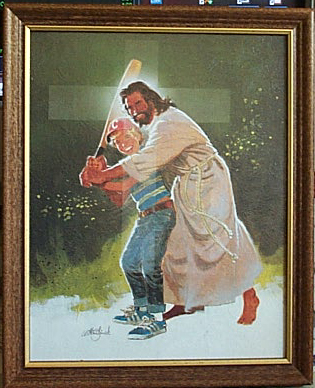
I think if Jesus was a baseball team he would be in last place.
Monday, April 14, 2008
The Well of Beer
At a place called Beer, the Lord provided a well for his people.
There the Israelites sang this song: "Spring up, O well! Yes, sing its praises!"
Numbers 21:17
There the Israelites sang this song: "Spring up, O well! Yes, sing its praises!"
Numbers 21:17
Saturday, April 12, 2008
That's the technology talking.
We’d call anyone stupid who used a saw for a can opener, or a pickaxe as a nutcracker. No, using the right tool for the task helps lower the risk of hurting ourselves (or others). The stupidity of these simple examples is plain to us because these tools are so low-tech, but we still learned these facts at one point or another. With high-tech tools though, the tasks they accomplish are much more complex, but likewise their purposes are much harder to discern.
Blogs. Blackberrys. Facebook messages. E-mail. Cell phones. Wall posts. Text messages. Of these, the only one I’ve not used is a Blackberry. In the past two years, every other mobile device and social networking tool has been in my relational toolbox. The ways to communicate keep multiplying. Staying connected is easier than ever.
I don’t need to tell you though that for all these tools, we’re not building better relationships. In high school, I was IMing with this one girl in my group of friends. I’d never really known someone to be so into other people’s lives and so willing to talk about them. During one online chat, I told her bluntly, “You’re a gossip queen.” Looking back, I can hardly believe I was so unkind. Who cares if it was true . . . what was I thinking?
This is sort of like the morning after being drunk. You remember enough of what you said last night that you have to call to apologize. You blame it of course on having too much beer. But in this case, the insulated feeling created by telecommunications is a false sense of security and the relationship suffers for it. "Baby, it was the technology talking! Please forgive me." Damage done.
I’ve found these new communication tools to be poor at building meaningful, healthy relationships with anyone. Maybe two years ago, I was discussing with a friend via email issues we both care about passionately. But over time, I sensed it slowly deteriorating, my own feelings toward him growing irritable, hurt, and even angry. It had never been like that before, when we’d talked face-to-face. What changed?
I’m not lamenting the poor quality of these tools though (or you could call use the word technology). In fact, I don’t think that these tools are poor quality. Rather, I think it’s user error. That is, I’ve used these tools poorly, inebriated with high-technology. As a kid, I always tried to be innovative and use an old tool in a creative way. (If you’ve ever watched The Red Green Show, they do this best.)
Can we really compare cell phones to pickaxes or e-mails to handsaws? Well, all of them are different types of technology humans use to accomplish various tasks. With communication tools, the relational element to them adds near infinite complexity alone. But they are still tools used for communication.
And while the purpose of a pickaxe seems pretty intuitive, it’s only because we’ve learned it. In the same way, the purpose of these high-tech communication tools will only become apparent if we really give them some thought. After that, they’re purposes might seem intuitive as well.
I'm only exploring the answers when it comes to these gadgets. I’ve tried to use them to accomplish certain tasks and relationships have suffered and bridges have burned because of it. Just like being the fool using a pickaxe for a peanut, I don’t want to look stupid or get hurt (or hurt others) just because I didn’t know what I was doing with the tool in my hand. Better than that, I won't have to call the next day to blame it on being technologically impaired.
Blogs. Blackberrys. Facebook messages. E-mail. Cell phones. Wall posts. Text messages. Of these, the only one I’ve not used is a Blackberry. In the past two years, every other mobile device and social networking tool has been in my relational toolbox. The ways to communicate keep multiplying. Staying connected is easier than ever.
I don’t need to tell you though that for all these tools, we’re not building better relationships. In high school, I was IMing with this one girl in my group of friends. I’d never really known someone to be so into other people’s lives and so willing to talk about them. During one online chat, I told her bluntly, “You’re a gossip queen.” Looking back, I can hardly believe I was so unkind. Who cares if it was true . . . what was I thinking?
This is sort of like the morning after being drunk. You remember enough of what you said last night that you have to call to apologize. You blame it of course on having too much beer. But in this case, the insulated feeling created by telecommunications is a false sense of security and the relationship suffers for it. "Baby, it was the technology talking! Please forgive me." Damage done.
I’ve found these new communication tools to be poor at building meaningful, healthy relationships with anyone. Maybe two years ago, I was discussing with a friend via email issues we both care about passionately. But over time, I sensed it slowly deteriorating, my own feelings toward him growing irritable, hurt, and even angry. It had never been like that before, when we’d talked face-to-face. What changed?
I’m not lamenting the poor quality of these tools though (or you could call use the word technology). In fact, I don’t think that these tools are poor quality. Rather, I think it’s user error. That is, I’ve used these tools poorly, inebriated with high-technology. As a kid, I always tried to be innovative and use an old tool in a creative way. (If you’ve ever watched The Red Green Show, they do this best.)
Can we really compare cell phones to pickaxes or e-mails to handsaws? Well, all of them are different types of technology humans use to accomplish various tasks. With communication tools, the relational element to them adds near infinite complexity alone. But they are still tools used for communication.
And while the purpose of a pickaxe seems pretty intuitive, it’s only because we’ve learned it. In the same way, the purpose of these high-tech communication tools will only become apparent if we really give them some thought. After that, they’re purposes might seem intuitive as well.
I'm only exploring the answers when it comes to these gadgets. I’ve tried to use them to accomplish certain tasks and relationships have suffered and bridges have burned because of it. Just like being the fool using a pickaxe for a peanut, I don’t want to look stupid or get hurt (or hurt others) just because I didn’t know what I was doing with the tool in my hand. Better than that, I won't have to call the next day to blame it on being technologically impaired.
Tuesday, April 08, 2008
Take A Minute

You have a lot of things you could, should, want, need to do.
Right now you are reading my blog.
Stop.
Think about somebody close in your life you will talk to today.
Put the laptop down or push back from the computer monitor.
Take 60 seconds. That's right a full minute! You will have several more of these today. Take that minute and pray for that somebody.
That wasn't hard was it?
Saturday, April 05, 2008
Are you watching Me?

Sometimes I just feel obligated to post something. This is one of those times! So we'll see where this goes.
I tend to be a private person over the Internet so I'm going to step outside and share where I am, what I'm doing. Just in case you are desperate to spy on me.
I'm reading a lot about Spirituality and Galatians
I'm listening to Steven Delopolous and Umbrellas
I spend time with friends here, here, and here
And of course here
I'm watching Dan Lugo
I'm loving the weather
I'm optimistic
I love playing here
You can stalk me here
That didn't take too long.... :)
Subscribe to:
Posts (Atom)
