Thursday, December 25, 2008

Rejoice


My Dad gave a meditation last night at a Christmas Eve service with the congregation he serves. He said

"The Christmas Story is a love story, about how much God loves us to send his one and only Son."


Amen and Merry Christmas!

Wednesday, December 24, 2008

What Child Is This?


What Child is this, who laid to rest,
in churches’ yards is freezing?
A manger low, out in the snow.
Illumined plastic, so pleasing.
This, this is Christ the King,
Who knows no bounds of humility.
Chased, chased, to lowest place
To raise us up to his glory.

We find him there but cannot bear
to put our faith in his teaching.
As cars go by, it’s no wonder why
the malls seem much more pleasing.
This, this is Christ the King,
Now at the curb for recycling:
Waste! Waste! The Son of God.
The world sees nothing worth keeping.

Words, flesh, for me, for you,
He died for us. We know its true.
But how we feel on Sunday morn,
Is rarely more than the music.
This, this is Christ the King,
These things we feel when we sing,
Safe, safe, inside the church.
But outside Jesus is freezing.

Why lies the world in sorry state,
with churches faring no better?
Good Christians, we still sinners be.
Let’s go to the curbside together.
This, this is Christ the King:
Despised, rejected, and suffering.
Taste, Taste, his love for us,
The God who's there at the curbside.

So raise, raise up Christ on high,
in hearts, with hands, for ears, for eyes.
For those who ask, "What Child is this?"
May we have something worth preaching.
This, this is Christ the King
Whom churches need for everything.
Haste, haste to bring Him back,
Let us descend for his glory.

Tuesday, December 23, 2008

Red with anger. Green with envy. A post for all emotions.

A few articles I wanted to share with you.

In keeping with Winter Advisory, the economic downturn continues to inspire new ways of keeping the roads clear. But we don't forego our ideals. Like the beet juice I mentioned previously, Iowa roads will be using garlic salt. Red, and now green! So Christmasy.

I recently posted on the humility of Christmas. I wanted to link there to this CT article that I read just before I finished writing that post, but it wasn't up on the Web yet. Now it is.

The Drudge Report pointed to an article today about President Bush and Veep Cheney and their clandestine activities with the War Vets from both Iraq and Afghanistan--it's something the media knew little about.


This made me laugh.

And I appreciated this reminder that Love Wins.
Friday, December 19, 2008

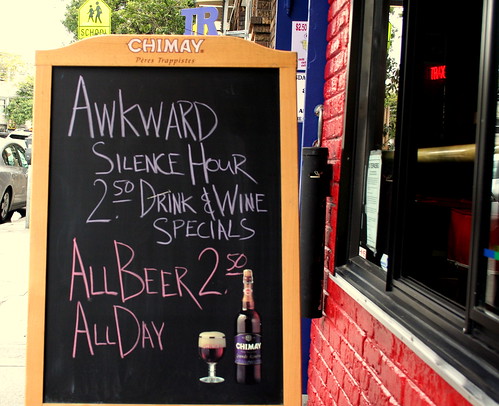
Awkward Silence


I hate lulls in conversation. In high school I would plan conversation topics before dates. Yeah... obviously that went smashingly well. At times, in an effort to avoid the conversation from stalling, I mentally prepare the next topic of conversation and how to move towards that end. But that is a pain and a tad controlling (a tad?).

Going out on a limb here...but I think many can relate to my behavior. We all have been in that situation where "awkward silence" has emerged. After a momentary pause somebody tries to sputter out anything to move from awkwardness to normallness.

I comment on this in light of conversations with God. I dont' mean to trivilaize God, like God is just one of the "guys," and we hang out, exchange stories, chill, because Jesus is my "homeboy." Rather, I mean conversation in terms of prayer.

And in my prayer life (conversation) I realize that many times I do the speaking. I try to fill in the awakwardness of silence.

Think about the start of your day. What is the first thing you do? Television? Check e-mail? Make a phone call? Turn on the radio?

About two months ago I realized I was in the habit of checking my e-mail in the morning. I rushed into distraction instead of waiting for a word from God. So by ways of this small testimony I challenge you to try to be silent before God.

Serioulsly, try this. Go into a room and sit. Don't do anything. I mean just sit. And see what happens. Let me talk you into some awkward silence.

Wednesday, December 17, 2008

Top Seven Nonfiction Books


Here's a list of my 7 favorite nonfiction books. Yes, 7. It's a good number. If you're looking for a good read over the holiday, I highly recommend them all.


1. Desiring God John Piper
Piper lays out the guiding principle for how I think about every aspect of my faith.

2. Renovation of the Heart Dallas Willard
Like Piper, Willard is a man crush. Renovation gave me to tools and knowledge to cooperate with God in becoming more like Christ.

3. The Trivialization of God Donald McCullough
God is big.

4. Roaring Lambs Bob Briner
This book was my initiation into thinking seriously about Christian engagement with a complex American culture. There are probably better books out there (e.g., Christ & Culture), but this book was seminal for me.

5. The Hidden Power of Electronic Culture Shane Hipps
Terrible title. Amazing book. This is an easy read with big ideas. I see better how technology impacts not simply what we think about but how we think.

6. A New Kind of Christian Brian McLaren
Put feelings into words. That's the sign of a good book. This is the book that started the Emergent conversation.

7. The Cost of Discipleship Dietrich Bonhoeffer
Bonhoeffer was a rebel who found a rebellion worthy of God. He's just a stud (i.e., man crush).

Tuesday, December 16, 2008

Verse

Musings about what to write on and this verse is all I have to share. I appreciate the NLT translation that keeps the season theme of Ecclesiastes 3 (shout out to Adam). This is one of those verses that perplexes and encourages me at the same time.

Ecclesiastes 3:11 Yet God has made everything beautiful for its own time. He has planted eternity in the human heart, but even so, people cannot see the whole scope of God’s work from beginning to end.

Monday, December 15, 2008

This year we’re scaling back on Christmas. Actually, that’s not quite accurate. My family is spending less on presents than has been our habit in recent years. But we may still spend as much this season as we have in the past.

The rebelcontrarian in me has had a vague notion to scale back for a few years now. But it took Advent Conspiracy to finally spark a conversation with my family. I wish it hadn’t taken some big media push by a special interest group. It goes against my nature. But I guess if it nudges someone like me in my position, then it’s accomplishing its purpose. And though I’d like to, I can’t take credit for it. Instead of proudly bearing my self-styled label—of being a hip minimalist and full of compassion—I have to lose that identity by buying into something bigger than me. Humility is easy except when it’s actually humbling.

So, at Thanksgiving we talked about how we could make this Christmas different. We threw around some ideas about what we could do as a family. We talked about working at a food pantry or finding some people in need. Did we know anyone? A recent speaker I’d heard said that our problem isn’t that we don’t love the poor but that we don’t know anyone who is poor. We were at a loss for names ourselves.

So far, our ideas had been okay, but they hadn’t really struck a chord with us. I knew that for this Christmas experiment to change our habits in a lasting way, it had to fit our family’s own personality. Sometimes it is good and necessary to introduce something foreign to our personality if it doesn’t allow for authentic good, but I still wondered if we couldn't find something intrinsic that would fit better.

“Well, when I was little we always went Christmas caroling to old people’s houses,” my sister recalled with a laugh. “Maybe we could go to an old people’s home and sing for them.” This idea met with more interest than what we’d already mentioned. Our family is a musical one, we all agreed. This was a good option.

“If we’re going with something natural for our family,” my dad said looking at me, “I immediately thought of Beth and Jake.” Beth is a single mother of Jake, who’s 9 now. We’ve known them both that whole time. “Of course, their basement was flooded this summer,” my dad went on, “so they have needs in that regard. And they’re someone who’s been a part of our lives for a lot of years already. It makes sense that we’d do something special for them.”

These ideas weren’t uncomfortable or beyond our means the way we often imagine things like this to be. But making a sacrifice doesn’t always need to be inconvenient, does it? Nor would these acts of compassion radically transform many lives, but they wouldn’t leave the people unchanged either. Small change is valid too. When the desire for big transformations prevents us from acting at all in small ways, we know that our desires have gotten out of order. Working for small change instead of big change is something that will require a humble spirit because there won’t be a visible reward. Humility is easy, except when it’s actually humbling.

But I think humility is part of what Christmas means, too. Consider this interpretation of Christmas:

“Though Jesus was God,
he did not think of equality
as something to cling to.
Instead, he gave up his divine privileges;
He took the humble position of a slave
And was born as a human being.”

We typically think this is out of character for God, but consider God's self-styled residence: "I live in the high and holy place with those whose spirits are contrite and humble." It makes sense then that God would choose a cave-barn. It seems fitting even. Maybe Jesus felt quite at home there. What kind of homes are we making for him?

We all know the story of Christmas. It's been so glamorized. But it wasn’t headline news when it happened. The work of God rarely is, by our standards. Headline news would have covered the astronomic anamoly in the night sky, not the birth it pointed to. "Huh," we would've shrugged before flipping channels. But the angels got their priorities straight and made it a big deal, just like they do when a sinner repents—another non-newsworthy event. God works like that: turning insignificance on its head, having parties for it. Humility is insignificant, except when God gets hold of it. So is small change.

Friday, December 12, 2008

A Matter of Life and Death


I know everyone is overjoyed that my brief blog sabbatical is over. After the e-mail and Facebook threats I caved in.

This post dates back to Black Friday...

On the evening of Black Friday I was flipping through the television. For some reason there was a BBC news feed and the British reporter was covering United States news. Now I have always thought Black Friday to be a joke and a sad example of America's obsession with consumerism. But this neutral report made me embarrassed. Authentically embarassed.

The news anchor explained, "Today in the United States was the holiday Black Friday."

I thought, "A holiday? People are defining this as a holiday."

He went on, " a day that almost rivals their annual celebration of Thanksgiving."

I thought, "How ironic that a day after being thankful for all we have we than go out to buy things we don't have."

Than came to worse part of the report. A man at a Wal-Mart in New York was trampled to death while people rushed the store. I than remembered my copy of Christianity Today (Nov). The lead article described the thousands of people lining up and fighting for food after devastating floods. Around 4 people were killed in the madness.

How sad. All the deaths are tragic but what struck me the most was the sheer contrast.

The Haitians flock for food. They gather for something to keep them alive and sustain them. We flock for good deals. We gather for something to purchase and enjoy.

If we had a better perspective on Thanksgiving/Christmas than perhaps Black Friday would be a day of sharing with people the things we are so thankful for. Like food for the Haitians.

I'm not trying to be a downer but just hoping to be a gentle reminder about blessing people this season, and all seasons. :)

Thursday, December 11, 2008

Why do seasons and songs feel the same?


I picked up my carpooling comrade from Midas this morning, where he'd dropped off his car for some maintenance. "Amazing the way mentioning an arrested governor sparks conversation in a service waiting area," he noted to me.

"It's sort of like the weather," I said. "We all have it in common." I recalled my high school job at a grocery store, when we carted groceries out for our customers. It was the store's special little touch to create a small-town experience for rootless consumers. I always made small talk with them about the weather.

"Yeah, I guess, we all have that in common. We all can agree on that."

"Right. For strangers, conversations center first around commonalities, not differences."

Movie quotes (and The Office, for that matter) function as universal inside jokes (if there can be such a thing) for our generation, I've noticed. If I want to establish a rapport with someone, finding commonality is essential. Tommy Boy is a good starting point. I've seen this happen with complete strangers.

Quotes can also establish boundaries pretty quickly because they work as a good indicator for how culturally hip someone is. Movie quotes will sound very non sequiter for the those who are unfamiliar with the movie. If you recieve a strange look or no response (anything besides laughter really), then you know your dealing with a culturally aloof individual. You have a good indicator about whether the friendship has potential. Why is that? Why do we evaluate possiblities by pop culture?

Another way we do this is with music. While we quote movies more often, I think music is more influential than movies. This could be argued, I'm sure. Music is a big way that individuals find commonality. This may be the first point of connection. Once, I mentioned to a group of friends a musician I had gone to see. One girl was very surprised. She hadn't pegged me for that sort of person. A few months later, we were dating.

Interestingly, on our first date she gave me a mixed CD of some of her current music. When I told my sister this, she said something like, "Oh, she wants to be known." It was true. Music is a window into our personal lives. It is a sort of revealing, a get-to-know-you. I knew a few of the songs, but most of them were unknown to me. I liked some, didn't like some others. A few months later, we weren't dating anymore.

I've also found that friends grow to share similar musical taste, or that they find out only after a while that they share an affinity for a certain band. What is it about music that we find commonality in it. Is it something intrinsic to the music that it appeals to certain demographics? Or is it that we've been bred by mass culture to use music that way, as a means for identity? It's probably somewhere in between.

Well, I could conclude my thoughts there, but that would leave the title of this post completely disconnected. I set out to write another post completely. That almost always happens. Often I never get to the actual post I'd intended to write. That will not happen this time.

I think music evokes feelings similar to those we associate with the four seasons. Some bands feel like Winter, others like Summer, Spring, or Fall. They have nothing clearly in common with those seasons, except that in the individual similar feeling arise in both contexts.

It was interesting then that when I asked some colleagues at lunch that we agreed about which bands fell in which seasons. It's interesting that for unique personalities, similar emotions are evoked by both seasons and music to connect the two.

That's all philosophical, and maybe a bit dry from some of you. All in all, I just wanted to post a list of bands (or CDs) that fell into the various seasons. Thanks to my colleagues who helped. And I guess it's a bit of a survey too. Do you agree that these bands fit their season? And what other bands do you think fit a distinct season emotively?

Fall
Eisley
The Fray
Sixpence, None the Richer
The Killers (late Sept)
Norah Jones' "Not Too Late"

Winter
The Myriad(?)
Counting Crows
Ingrid Michaelson
Pedro the Lion
Norah Jones's "Come Away with Me"
Keane
Coldplay (Winter/Spring)

Spring
Switchfoot
Sufjan Stevens
Norah Jones' "Feels Like Home
U2 (May)

Summer
Jack Johnson (Spring/Summer)

Wednesday, December 10, 2008

Going Out on a Limb

I like visual flow charts like the tree below. They help me figure out where I am. My heritage is Mennonite, but I went to Baptist churches a lot growing up. Now? I'm not sure where my beliefs would put me. I wish they had a test you could take to tell you which denomination you fit with best.

What's your story?

Monday, December 08, 2008

TV is new antidote for infectious happiness

If you’ve been a regular reader of Watching Gravity for a while now, bless you. You probably already know then that I have a strange fixation with the subject of happiness. It seems that every few months a new spate of articles surface on the topic as some new research comes out. Then, I link to them here and bore you all to death. For all our interest in being happy, reading about happiness seems a bit removed and unexciting, I suppose. So, indulge me again as I offer up a few more bits gleaned from recent reading.

The most interesting feature of recent articles is the impact that relationships have on happiness. For example, recent research points out that those who read more and socialize more are generally happier (See! You’re halfway there already!). But it’s more likely that happy people tend to read and socialize more, and not that those things make people happy.

By contrast, increased TV viewing is correlated to decreased happiness. But the same thinking follows here: It is unhappy people who tend to watch more TV, and not TV-watching that makes people unhappy (so keep watching!). TV is actually a means of immediate gratification, even if short-lived and rather shallow in the final analysis. One researcher said that TV simply functions as an “opiate.” I guess opium makes people happy. I don’t know that I’ve ever met someone on it.

Further research up on the Internet last week on the social impact of happiness claims that happiness is contagious, to a crazy degree. You don’t even have to know the person and they can have an impact on your happiness. "If your friend's friend's friend becomes happy, that has a bigger impact on you being happy than putting an extra $5,000 in your pocket." You’ll be happier if your friend-twice-removed is happy than if someone gave you 5 large. That’s hard to believe (but it’s science!).

But they point out the most important factor. While happiness might seem like the quintessence of self-centered individualism, it’s intrinsically linked to community, to being connected. "You have to see them [your friends] and be in physical and temporal proximity.” This seems in keeping with the previous TV findings in saying that happy people socialize more. Happiness correlates to being in community with others.

In their Nov/Dec issue, Books & Culture, a favorite periodical of mine, employed Scot McKnight to author an article on the topic. It is fitting for me, who takes everything seriously (it’s ridiculous), that I would be, ahem, happy to see a serious contemplation of happiness.

McKnight cites one author’s book and again connects happiness to community, but in a different way. “The best way to predict our feelings about tomorrow [= happiness] is to see how others are feeling today.” That is, find others who are already living the way we expect to be living in the future. We’ll see better where we’re headed. It’s less about community as a context for contagious happiness and more of one as an indicator for how sick we could get.

Thursday, December 04, 2008

UNO as Violence

This weekend my brother-in-law brought along some DVDs recorded at a recent conference that a colleague of his attended. The sessions included some popular figures within our happy subculture, including Shane Claiborne and Tony Campolo. Both figures are somewhat radical in their respective ways, challenging some of our habits of living as Christians in the United States. For this reason alone, I am inclined to like them

Tony Campolo’s talk was very big picture in some ways. He began with some axioms for interpreting Revelation. This seemed strange for a youth conference, but whatever. He began by interpreting “Babylon” and the “New Jerusalem” as symbolic. Babylon, he said, represented the Roman Empire for the first readers of Revelation—that is, it was the pervading culture of the day. It was then, and is now, the pervading value system by which we live and choose and the pervading object in which we put our trust. New Jerusalem represented Christians in the world—the Church. He argued that the New Jerusalem counters Babylon’s pervasive systems and remains standing after Babylon falls (Rev 11:15). He repeatedly encouraged people to reread Revelation 18­-19, indeed the whole book, with this interpretive framework. I plan to do so.

From his premises, he made an immediate jump from Babylon as the Roman Empire to Babylon as the United States. Now Babylon is different, he said, for different people around the world: For the French, Babylon is France; for the Chinese, it’s China; for Brits, Britain. As Revelation asserts, Babylon falls—"all Babylons fall." In the U.S. context then, it is no exception. For we who can’t imagine it, Campolo made this seem like a real possibility. We have, at the moment, an economy that is crumbling before our (mediated) eyes. Whatever the reasons and causes, legitimate or perceived, the financial system that has structured our value systems and in which we have put our trust is crumbling. Campolo himself talked about his own 401k, on which he was relying in his retirement. He began to explain what he thinks it means for the New Jerusalem to stand when Babylon falls.

During a Q&A session after his talk, Campolo’s big-picture ideas were made more applicable through some specific questions. The conversation there seemed to revolve around retirement accounts and medical insurance. One question asked if 401ks weren’t simply good stewardship. This is a legitimate question, and if we were to take Campolo’s challenge seriously, it is one that is of great impact on our own decisions. Should I plan and save for retirement, or does that make me like the rich man who built bigger barns to store his stuff, and to whom God said, “You fool!”?

In regards to medical insurance, Campolo referred to preceding speaker Shane Claiborne and even the Amish. Claiborne is known for radical compassion and the new monasticism he is leading in Philadelphia. There he lives in the ghettos among the poor, the homeless, the weak, and the least. He has pulled together with about a hundred others, committing to help pay for any medical needs that arise among them. Upon reflection, this seemed to me like insurance on a micro scale. It is like an insurance company, except it functions within the context of relationships, not corporations. Everyone knows each other in this context, whereas a typical insurance company is disembodied and impersonal. I think this is a key distinction for Claiborne.

This led, like usual, to some lively discussion in my family (we’ll discuss anything). I attempted to argue for Campolo’s views within the American context, while my sister raised good points about how impractical it is here, “pie in the sky” was her term.

“You’d have to be very committed,” she said, “to making such a thing happen. To pull together a hundred other people committed to the same thing to make it work at all.”

She’s right. You only have so much energy to commit to various causes of life, and you must care about this one area specifically to really make a go of it at all.

“Besides, doing it might take quite a while, and I don’t know where we’ll be five years from now.”

To this I suggested that perhaps staying in one place could be more important than moving to the next location. This sort of stability and longevity is obviously something that has been in my thoughts recently, so it was interesting to arrive there in conversation.

“But we don’t feel God is calling us to do that,” my sister was saying.

It was a trump card I couldn’t beat.

Still I wonder if the whole system we’ve built up around ourselves is a system in conflict with these values, which Campolo was suggesting were biblical, and which Claiborne agrees with by the way he's living. In this U.S. context, the ideas of providing for each other’s medical needs or providing for the elderly indeed seem like “pie in the sky” as my sister said. In fact, I often feel this tension when reading my Bible. I find myself asking, “Is this a nonnegotiable? Should I be doing more of that and less of this? Is Jesus' call, God's will, really that extreme?”

Later in the evening, some friends were over. The young boy determined that we should play UNO. I was amenable to it, and we all ended up playing four rounds. I was sitting next to my dad. Now when we play our usual game, Scrabble, it often goes poorly for him. He becomes somewhat despondent in these games where luck outweighs strategy. He starts to draw bad letters, and things just decline after that. He increasingly rubs his face and gasps, “Gosh!” Sometimes he just becomes a bit belligerent toward fate. It seems that fate dealt him similar afflictions in UNO.

As the game progressed, I was regularly playing cards like “Draw Four,” “Draw Two,” “Skip,” and “Reverse.” The consequences often fell on him. With each blow he alternated between glaring at me and pleading with me. At one point, he’d missed four turns in a row. At another point, he was rifling through at least 20 cards to find a yellow—without luck. I couldn’t help it. What could I do? That’s how the game is played.

Then I was reminded of what Campolo was trying to show us. Just like Babylon, UNO functions on a certain system of principles, a set of values. It has certain cards that you must play to win the game. You can’t play UNO without doing violence to your opponents by adding cards to their hand or preventing them from playing in a given round. In fact, every participant is an “opponent.” There is no community in UNO, only division.

Campolo was saying something like that I think. And I think Jesus is often saying it too, that despite what we’ve been led to believe, we don’t have to play the cards we’re dealt. You have a “Skip” and a “Draw Four” in your hand, but no one's forcing you to play them. Draw again for a card that won’t hurt your opponent. In fact, quit thinking of him as an “opponent” at all.

Of course you will also lose the game. But it begins to sound a bit like words Jesus spoke. Words like, “Love your enemies” and “Whoever wants to be first among you must be your servant.” These are two axioms by which the New Jerusalem will be standing long after Babylon has fallen. All of Jesus words, really, are the foundation of that whole city.

We are not called to quit playing UNO. We are called to quit playing by the rules we’ve been taught. You have the cards to harm your neighbor, but you don’t play them. You don’t skip over them or reverse course to avoid them, even if it may be to your own advantage. Often it will be. You don’t need to pile them with burdens that you yourself could help them bear, even if they burden you unjustly in return. In fact, you don’t just refrain from harming them, you find ways to help them out.

Tuesday, December 02, 2008

Winter Advisory, or Beeting the Streets


Saturday afternoon, I was in Iowa when it started to snow. With weather patterns the way they are, I knew that I’d be travelling into more snow Sunday driving back to Chicago. Weather is an important variable for people who are travelling. A light snow fall in town can be a blinding, accumulating travel hazard on the highway. Knowing what the road conditions are and what inclement weather drivers will face is valuable information. Is it a blizzard or a light dusting? How many inches? In the summer, there are thunderstorm and tornado watches and warnings. I still can’t remember which is which. If you’re with my sister when one of these comes up, the difference doesn’t matter, you’re going in the basement.

I went out to eat with my parent Saturday evening where the waitress—a blond who’d exhausted herself with a 14-hour day—informed us that there was a “winter advisory” out.

Now, as ill informed as I am about the difference between watches and warnings, I think “winter advisory” is just weathermen getting together and saying, “Let’s make our jobs legitimate when we have no weather to report. When it’s cold out we’ll call it a ‘Winter Advisory’!”

This is as absurd as having a Fall advisory or a Summer advisory. “Watch out for falling leaves. Ladies and gentlemen, just to be safe, we’re going to issue a Fall advisory, ” The National Weather Service is even in on the Winter Advisory kerfuffle. But who could say with a straight face, “The National Weather Service has issued a Summer Advisory. We encourage all people to take shelter or find some shade. It’s just too sunny outside today.” Oh wait, that’s what the UV Index is for.

I just don’t get how you can warn people about a season. Beware! It’s Spring outside today. You might want to wear layers, or at least grab a light jacket before heading out the door this morning.

While the weather forecasters are thinking up new ways to keep us advised, the economy has forced state and local road crews to find alternatives to salt for our streets, which is in short supply apparently. Just like snackers around the holidays, the roads are getting a mix of salty and sweet this year. The typical salt brine solution is now being supplemented with sugar beet juice. It looks like it started last year in Ohio and Indiana, then Chicago adopted it late in the season.

So, if you’re environmentally conscious but also concerned with appearing hip, you would do well next time you see snow removal trucks on the road to point them out to your friend and mention how great it is that they’re “beeting the streets.” If your friend looks at you funny, it’s clear that you should have compassion and enlighten her about why it’s no longer called “salting the streets.” You’ll be doing her a favor.

Sunday, November 30, 2008

Me vs. 5 Year Olds.....bring it on!

I am a peace-loving person so allow me this audacious speculation.

In college I was blessed with a great group of friends. My favorite activity we did was talk. During meals (and especially after) we would entertain ourselves with conversation. Normally the topics were ridiculous and absurd. But always hilarious.

One of my contributions took place during our sophmore year. Sitting in the commons after dinner I asked the question, "How many 5 year olds could you beat up?" We discussed what qualified "beating up," where this would take place, the resources at your disposal, etc.

During my time in Scotland and here in Chicago my friends have also been humored by this conversation topic. Our imaginations can be absurd!

I shouldn't be surprised that we aren't the only ones. If you go to this interactive website it will tell you exactly how many 5 year olds you could take in a fight. The website is aptly called How Many Five Year Olds Could You Take in a Fight?

I'm not going to lie, when my brother-in-law sent me the link I was a little too excited. This helps me know that I am not alone in the world.

I can take 23.

(Take a note of the forum that inspired this blog. After the idea was posted there was over 50 responses in 45 minutes!)

Wednesday, November 26, 2008

Best/Worst

Not that you need to know this but I thought of this post in the shower last night. Remember that show Best Week Ever, on VH1? Actually it might still be on so I might be showing some ignorance. Well here is the best and worst of the last three days. Very random categories. I think I thought of better ones last night but oh well....

What I heard on Monday at the high school

Worse-A teacher told me, "The next class you have is a challenge and some pretty bad kids."

Best-Two kid's conversation, "Chuck Norris' tears cure cancer. Too bad he never cries."

What I saw on while running Monday

Worse-A Salvation Army ringer outside of Walgreens with Christmas music blarring. Come on, let's wait until T-giving.

Best-my apartment, because I was done running.

What I heard on the radio

Worse-This song called Hot n Cold by a girl name Katy Perry. One line goes, "You change your mind like a girl changes clothes." Great simile.

Best-The song Two Set of Joneses by Big Tent Revival. That is old school Christian music. Also one of my sister's favorite songs!

What I thought

Worse-This semester is ending soon. I have a lot of work to do.

Best- I have a couple days off to get some homework done.

What I ate

Worse--Some cantaloupe that tasted like it was dug out of the trash.

Best-Some cornish hen. Never had it before. Thanks to my bro and sis-in-law.

Football I watched

Worse-I watched the St. Louis Rams play a little bit. That is bad.

Best-PSU beat MSU. Every year we have a bet and the loser has to make the winner creme puffs. So Dad, get out your famous recipe.

What I saw driving

Worse-Chicago traffic

Best-Does that gas station sign say $1.76?

Tuesday, November 25, 2008

Fixed Points


“The next place I live,” Mike was saying, “I’m going to settle in. I’m going to have a place for everything and really unpack.” We were talking about the next chapter, after this apartment. In a few months, all of the current tenants here will be looking for new homes. They’re making the building ready for sale. This change wasn’t unexpected really, just not for that reason. Mike has been in school the past three years, and he’ll be done in the spring too. I’d always anticipated we’d all move out after he graduated.

About the time we found out about our deadline, our apartment building became the set of Friends (since everything in real life is defined by hit TV comedies). I live with two other guys, and on the floor below we have three female friends who live together. When they all moved in, I proposed that we have community dinners together once a week. We’ve been doing it now for only a month or two, but I look forward to it every week.

When we moved in, I had no idea that I’d still be here two and a half years later, or that it would feel this familiar. I think when most people think about the future, they project it out in straight lines from the present. What we can’t foresee are all the lines that will intersect with our own and change our course, in small and large ways. There are certainly intersections we hope or plan for, but they aren’t certain, and there are many more we just can’t anticipate. For a single 20something, intersections can change a lot of things. I don’t have to tell you that.

I was reading an article this weekend about cell phone and they’re being used by billions of impoverished people. It’s saving them time too. When a billion people are each saving a little bit of time, that’s a lot of time savings. It’s a small change, but it creates a big difference.

In the article, this line hit my life: “In an increasingly transitory world, the cell phone is becoming the one fixed piece of our identity.” How long have you had your cell phone? I’ve had this model for about a year. I’ve had this phone number for probably six or seven years. Anyone I’ve given my phone number in the last 2000+ days could call me tomorrow and get a hold of me.

That could be a scary thought, but it’s that reliable. I haven’t had anything in my life that stable in the last six or seven years. Since then, I’ve lived in three states, called at least five places “home,” dated a few different girls, bought a new car, worked three or four jobs, and had maybe a dozen roommates. My cell phone has been one of the few settled parts of my life, and even at that it’s only the ten digit number, not the physical phone (I’m on number 3). Why is something mobile the thing I can rely on most?

Recently I also started reading a book called Searching for Home: Spirituality for Restless Souls. It was selected at a book club I’m a part of. I didn’t go looking for a book to tell me how rootless my life is, but it came and found me.

All in all, it’s had me thinking more about the upcoming move. Mike was speculating last week about where the whole cast would end up after the series finale in May. He rattled off where he thought each character would be. Closer to work, closer to home, out of state, toward downtown, with another friend. He didn’t tell me where I would be. Even I only have a direction: northeast. Like Abraham (the similarities end there).

Most clear from Mike’s quick analysis was that none of the cast would still be together in 8 months. We would be dispersed in all directions from here. We would all find a new place, with new casts, new shows. We’d be new characters.

In Searching for Home, Craig Barnes outlines how we, without other stable points of reference, establish identity in relation to the roles we have in our lives. For me, in different contexts, I am a supervisor, a friend, a roommate, a small group leader, a brother, a son, an uncle.

Barnes put it this way: “The individual becomes nothing more that a collection of roles defined by unrelated demands.... She knocks herself out to succeed in all of the identities because they each offer her something.” He goes on to quote Kenneth Gergen: “Who and what we are is not so much the result of our ‘personal essence’...but how we are constructed in various social groups. The initial stages of this consciousness result in a sense of the self as social con artist, manipulating images to achieve ends.” As much as I try to live consistently, I can’t, if only because different people bring out different sides of me. Things like Facebook and even this blog are a challenge because it is the intersection of many of those images.

Of course, my cell phone isn’t the most stable thing in my life. I should say that God is, and I believe that’s true. But when life takes a new trajectory at every intersection, it’s hard to approximate anything like the stability of relating to the immutable God. When I can’t project a straight line off the front of life into the future with any certainty, then outlining what an lasting relationship looks like feels quite impossible. It’s outside my experience.

This summer, I attended a meaningful and heartbreaking funeral. He was the father of a friend of mine. Three people gave eulogies: two “old friends,” and one “new friend.” The two old friends had known him for more that twenty years. I sensed in their words an abiding knowledge of him, a commitment to him, and a desire to carry on the investments he’d made in them. I wondered what that was like.

There are a lot of people who pick up and move to advance their careers and build better lives. And perhaps one day I will find myself faced with a decision like that. But I witnessed in those eulogies something that no career could build.

I’ve lived in Chicagoland now for three years and been committed to a church that comes and goes in much the same way. I’ve led a small group that whole time and have probably had 40 people come and go. Only two or three of them have I known in any consistent way for more than a year.

Now, I’m certain that any sort of faithfulness on my part will never approach any similarity to our reliable and unchanging God. And I’m learning that few 20something friendships last longer than a few seasons of Friends. But I can take a more modest aim and hope to be more faithful and reliable than my cell phone number.

Monday, November 24, 2008

Rock Steady


I titled this post and then realized it is the name of one of the bad guys in Teenage Mutant Ninja Turtles! Don't act like you didn't know that already. Everyone loves TMNT.


I woke up at 6:50 this morning to my phone ringing.

The voice said, "Hi Mike, are you available to sub today?"

After fighting through my pillow I managed to say, "yes."

So in an instant about 20 minutes I rearranged my other work schedule. Canceled/re-arranged a meeting. Decided that the Greek homework would have to wait. Looked up directions from the high school to the airport to pick up my friend, etc, etc.

I'll be honest, it's not always fun. My day can instantly because of a phone call from someone I have never met before! Since today was altered it means that the rest of the week is changed as well. I push back appointments, time to do homework....and I just realized while writing this I missed a meeting today. Whoops. I totally stood somebody up.

My evening was just as unpredictable. Soccer game, canceled, back on, canceled again. Stopping to visit a friend, he's gone, he's back home, calls me, too late. Meeting friends later in the evening. We play phone tag. Where are we meeting? When?

All this to say that as I sit here, prepping for bed, one thing remains steady. That thing is what I read this morning. I can't explain it but these words just keep echoing in my mind. I don't know how or why but they do. It's nice that with all the variables and changes there is consistency...

Psalm 62:1-2
For God alone my soul waits in silence; from him comes my salvation. He alone is my rock and my salvation, my fortress; I shall never be shaken.

Thursday, November 20, 2008

Silence and Solitude in Bonhoeffer and Foster

Many people seek fellowship because they are afraid to be alone. Because they cannot stand loneliness, they are driven to seek the company of other people. There are Christians, too, who cannot endure being alone, who have had some bad experiences with themselves, who hope they will gain some help in association with others. They are generally disappointed. Then they blame the fellowship for what is really their own fault. … The person who comes into a fellowship because he is running away from himself is misusing it for the sake of diversion, no matter how spiritual this diversion may appear. He is really not seeking community at all, but only distraction which will allow him to forget his loneliness for a brief time…. (Life Together, 76, online here)

Jesus calls us from loneliness to solitude. ... Our fear of being alone drives us to noise and crowds. We keep up a constant stream of words even if they are inane. ...But loneliness or clatter are not our only alternatives. We can cultivate an inner solitude and silence that sets us free from loneliness and fear. Loneliness is inner emptiness. Solitude is inner fulfillment. Solitude is not first a place but a state of mind and heart. It is quite possible to be a desert hermit and never experience solitude. But if we possess inward solitude we will not fear being alone, for we know that we are not alone. Neither do we fear being with others, for they do not control us.

Without silence there is no solitude. Though silence sometimes involves the absence of speech it always involves the act of listening. Simply to refrain from talking, without a heart listening to God, is not silence. One reason we can hardly bear to remain silent is that it makes us feel so helpless. We are so accustomed to relying upon words to manage and control others. If we are silent who will take control? God will take control; but we never let Him take control until we trust Him. Silence is intimately related to trust. (Celebration of Discipline, 84, 86, 88)

Silence is nothing else but waiting for God’s Word and coming from God’s Word with a blessing. But everybody knows that this is something that needs to be practiced and learned, in these days when talkativeness prevails.

The day needs definite times of silence, silence under the Word and silence that comes out of the Word. These will especially be times before and after hearing the Word. The Word comes not to the chatterer but to him who holds his tongue. The stillness of the temple is a sign of the holy presence of God in His Word. (Life Together, 79, online here)

That's Indignorant

Adam introduced a new word to me; indignorant.

Indignorant-describes a person who is both indignant and ignorant. Most commonly becoming defensive and indignant when confronted about their ignorant speech or behavior.

Somebody was indignorant towards me on Monday. Substitute teaching provides for so many good stories. Aout 20 minutes ago, a 2nd grader asked if I would change the music in gym class because he didn't want to listen to High School Musical. I asked what he wanted to listen to instead. He said, "well if it was me I would put in Thriller, by Michael Jackson." Nice.

Back to indignorance. On Monday the 8th grade class was commenting on how I look like Jesus. (Nothing new) After a quick history lesson on how Jesus would actually look I said, "I look like a Scottish-German American, not a first century Jew."

A spunky little blonde hair girl stood up and scowled at me. She boldly spoke up and said, "Mr. Moore, Jesus was Catholic, not Jewish."

That's indignorant.


Wednesday, November 19, 2008

Blogroll Call 2

Despite advice to the contrary, a number of friends have started blogging in recent weeks. I wanted to give them a shout out from Mike and I here. I've also been meaning to post some other interesting posts that I've read recently that I really appreciated.

"Klyn" started blogging at Wonder and Wandering, a homonym pair I love. She posted some reflections on her experience at a recent Fall Retreat. I was there too, and we had a great time.

A newer friend of mine (since August I was informed), Laura, is blogging about her life. Among her interests are cooking and useful dogs. I've learned more about Laura's personality from her blog, and I really appreciate how different it is from ours here. She recently pondering the "Etiquette of Blogging," which is something I've posted on around these parts. But that was back before we were friends.

Rachael told me just last night that she'd started blogging. "I posted like 5 or 6 posts before I told anybody because I wanted to make sure I would actually do it before word got out." Well, the word is out. She posted on something close to my heart: "Community Dinners." I haven't even read it yet, but she said she talked about me (and my singing, I think), so I may regret linking to that post.

On my last Blogroll Call, I mentioned the Wolff Pack and Parisi Images. They both had posts recently that I really enjoyed.

Bryan Wolff posted "The Downpour of Worldliness." Now, I'm not a big us/them division fan. But I appreciated his reflections as a dad. It definitely hit me in the chest. His metaphor was powerful.

My photographer friend over at Parisi Images had some great reflections on "Experiencing Art." She makes some great insights on the aural and visual art experience, and how we generally experience it in a way antithetical to how it would best be experienced. I'm butchering it. You just have to read it.

Finally, my friend Dan, who lives in the room below mine and often sings me to sleep through the floor, pointed to an article in the Naperville Sun about a woman who threw a birthday party for the homeless in downtown Chicago. It's well worth your time. It's another one that hit me in the chest.

Oh and one more, from a blogger I don't know: a good poem called "Autumn Day" by a poet I've never heard of.